Year-End Ops: What Your Operations Actually Require (Before December Shows Up)
Year-end isn't a January problem — it's an October one. Here's the checklist of records, reports, and vendor renewals to close out before the December scramble starts.
There’s a particular kind of stress that hits operations in the back half of December, and it almost never comes from the work itself. It comes from the work that was supposed to be done by now and wasn’t—because nobody owned it, because the reporting deadline felt far away in October, because the vendor renewal notice went to an inbox nobody was watching in November.
The businesses that close out the year cleanly aren’t the ones with bigger teams. They’re the ones that started the cleanup in October, when there was still time to fix something without it becoming an emergency. Here’s what year-end actually requires—and how to get ahead of it before it gets ahead of you.
1. Close Out Your Records Before the Calendar Does It for You
Open records are the quietest tax on a small operation. A half-closed job ticket that nobody marked complete. A lead that went cold but never got moved off the active list. A project that wrapped in September but is still sitting in your pipeline because nobody updated the status. Each one is small. Together, they’re the reason your numbers don’t tie out in January.
The fix isn’t heroic effort. It’s a clean pass through your records before the year turns—reconciling statuses, archiving the closed work, and making sure what’s left on the board is actually still alive. The longer open records sit, the more they blur into the background noise of “I’ll get to it.” A year-end close out is the discipline of getting to it before it becomes someone’s January problem.
2. Year-End Reporting Has More Teeth Than Owners Realize
Most owners think of year-end reporting as “the accountant’s problem.” It’s not—not entirely. The reports that bite aren’t usually the tax filings. They’re the operational ones: usage summaries that determine next year’s pricing, compliance attestations tied to how data was handled all year, client reporting deliverables that were promised in a contract nobody re-read.
The trap is that these requirements rarely surface in December. They surface in January, when someone asks for something that had to be compiled from records that were already supposed to be clean—and now they’re not. A reporting requirement you discover in October is a task. The same requirement discovered in January is a scramble, and scrambles are where mistakes live.
Walk through your contracts and vendor agreements now. Flag every “by year-end” or “annual” obligation. Half of them will be quiet—the kind nobody reminds you about until they’re late. The other half you already know about but haven’t started. Both are cheaper to handle in October than in December.
3. Vendor Renewals Are Quietly Expensive When You Don’t Review Them
Here’s a line item most small businesses never audit until it’s too late: the tools and services that auto-renew every year. The CRM seat count that crept up because nobody removed the people who left. The software license you upgraded for a project that ended six months ago. The service that made sense at last year’s volume and doesn’t anymore.
Auto-renewals are designed to be frictionless—which is great for the vendor and quietly expensive for you. The window to review them is now, before the renewal date, not after the charge hits. A thirty-minute audit of what’s renewing in Q4—and whether you still need it at the same tier—often pays for itself before January 1.
This is also where operational debt shows up. A tool you added to solve a problem, that’s now paying for a problem you already solved elsewhere. Two tools doing the same job because nobody consolidated. A plan tier you outgrew the need for but never downgraded. Each one is a small leak. Together they’re a budget line that quietly grew while nobody was watching.
4. Get Ahead Instead of Scrambling in December
The reason year-end work becomes a scramble isn’t that it’s hard. It’s that it’s unowned. Nobody’s job title says “close out the year cleanly,” so it falls to whoever’s standing when December arrives—usually the owner, usually at night, usually with a deadline the next morning.
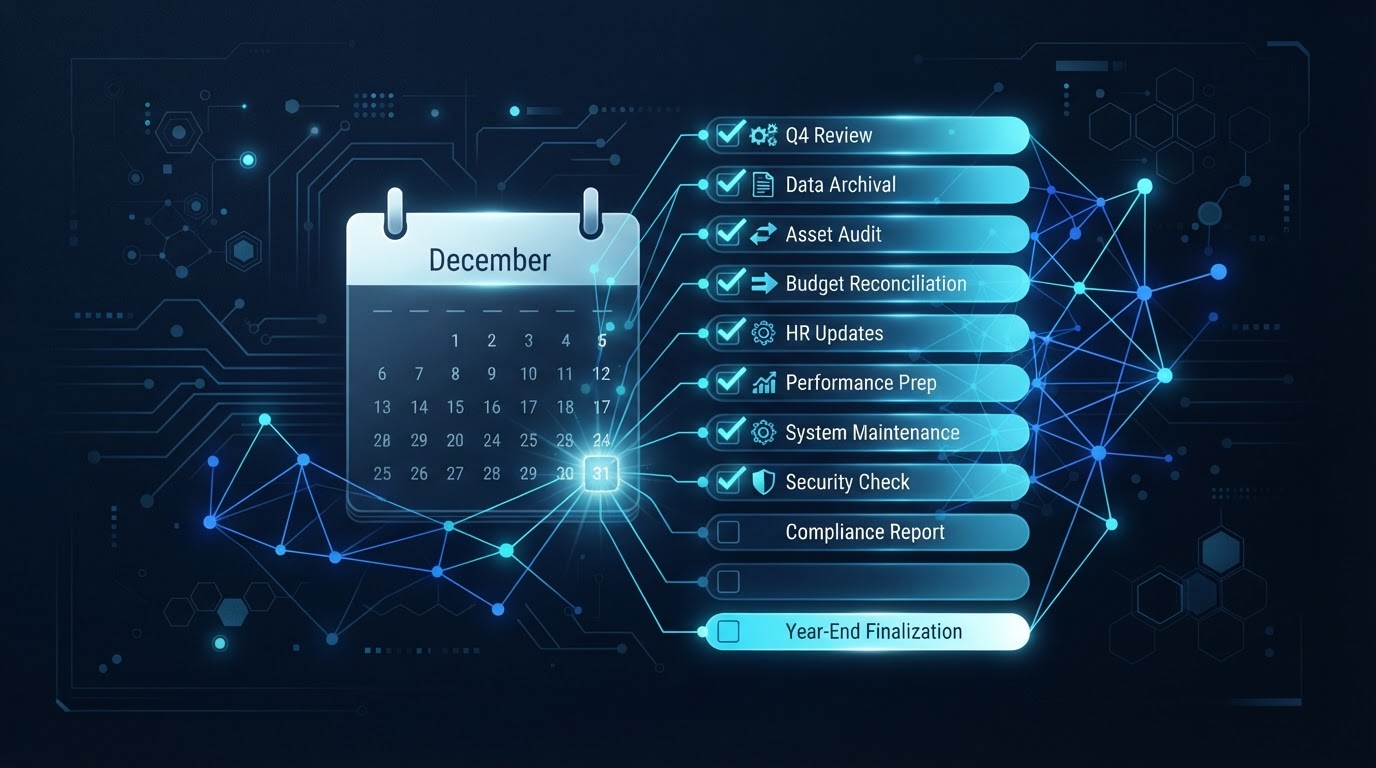
A year-end ops checklist, started in October, is how you change that. Not a strategy document. A short, honest list of what actually needs to close before December 31: the records to reconcile, the reports to compile, the renewals to review, the statuses to update. Three things you can start this week. Two more next week. By the time December shows up, the only thing left is the celebrating—and maybe a vendor or two who still needs a yes or no.
The businesses that start the year ahead aren’t the ones with the most resources. They’re the ones that realized year-end is an October problem dressed up as a December one—and treated it that way. Start your year-end ops checklist.