Why 'AI Strategy' Is the Wrong Starting Point for Most Small Businesses
Strategy decks don't save anyone an hour on Monday morning. Here's why picking one painful workflow to automate first beats a grand AI plan every time.
If you're a small business owner in 2026, you've probably been told you need an "AI strategy." Maybe a consultant showed you a slide deck with five pillars and a roadmap. Maybe you sat through a webinar about "digital transformation." Maybe you even paid someone to write you a ten-page document that now lives in a folder nobody opens.
Here's the problem: strategy decks don't save anyone an hour on Monday morning. They don't answer the phone. They don't follow up with the lead from last Tuesday. They don't fix the spreadsheet that takes three hours to update every Friday. A strategy is a map — but most small businesses don't need a map. They need to start walking.
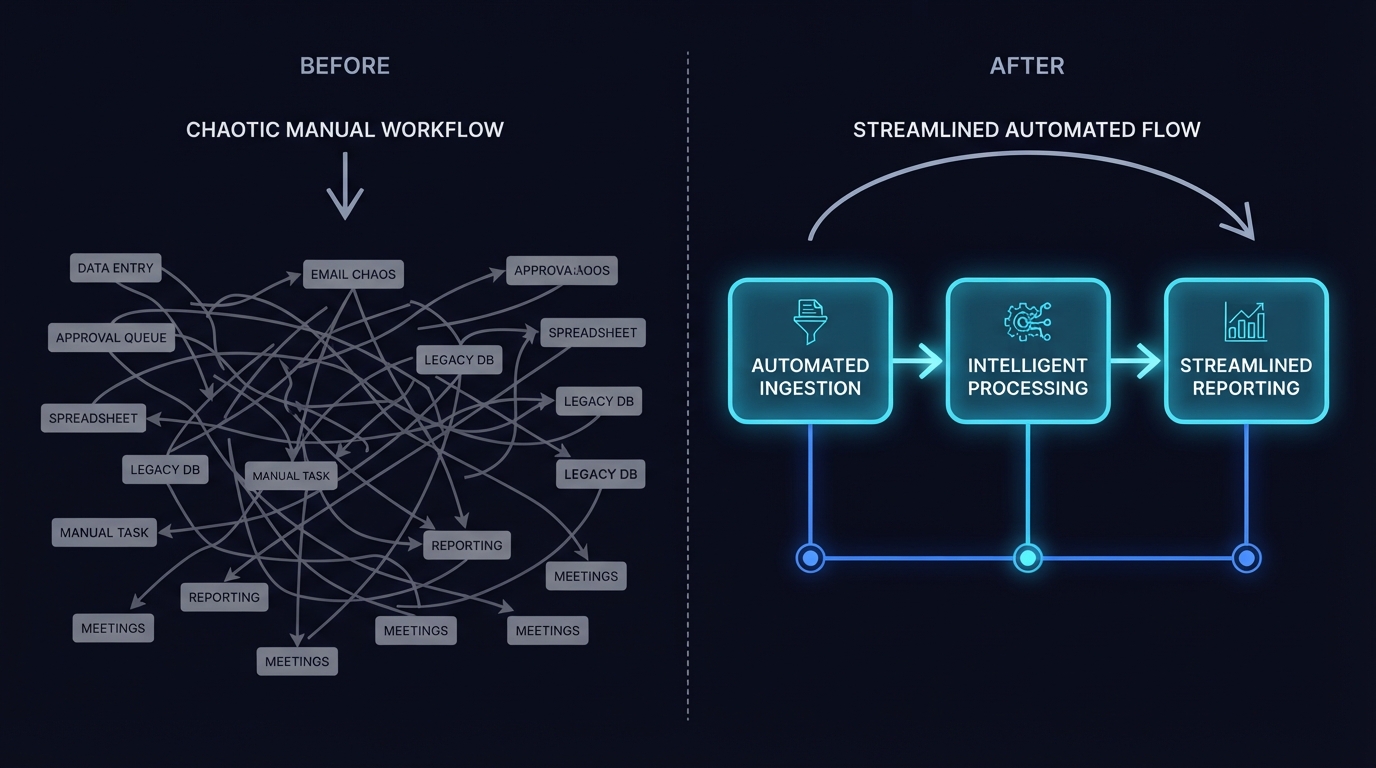
Before vs. After: What Actually Changes
- ✕ 10-page AI strategy doc nobody reads
- ✕ Five tools bought, none fully set up
- ✕ Same manual busywork every week
- ✕ No measurable improvement
- ✓ One painful workflow automated
- ✓ Hours saved, measured and proven
- ✓ Team trusts the system
- ✓ Clear next step, not a foggy roadmap
1. Strategy Decks Don't Save Anyone an Hour on Monday Morning
There's a certain kind of consultant who'll spend two weeks interviewing your team, mapping your processes, and producing a beautiful document with a SWOT analysis and a phased rollout plan. It'll have color-coded timelines. It'll mention "AI readiness" and "change management." And then it'll sit in a Google Drive folder while you go back to doing the same work the same way.
That's not because the strategy was wrong. It's because strategy without execution is just expensive procrastination. The deck describes what could change. But on Monday morning, when a customer calls and nobody answers, when a lead sits in an inbox for three days, when someone spends two hours copying data between systems — the deck doesn't help. The work still has to get done, and it still gets done manually.
Small businesses don't fail at AI because they lack a strategy. They fail because they confuse having a plan with making progress. The businesses that actually benefit from AI are the ones that skip the deck and start fixing real problems.
2. Pick One Painful, Repetitive Workflow and Fix That First
Instead of trying to "transform your business with AI," pick one thing. One specific, painful, repetitive task that someone on your team groans about every week. Maybe it's data entry — copying customer info from emails into a CRM. Maybe it's scheduling — the back-and-forth texts to book a job. Maybe it's the weekly status report that someone assembles by hand from three different systems.
Whatever it is, it should meet three criteria: it happens repeatedly, it follows a predictable pattern, and it eats real time. If a task meets all three, an AI agent can almost certainly handle it — or at least handle the first 80% of it so a human only steps in for the exceptions.
The reason this works is psychological, not technical. When you automate one painful task and your team actually feels the relief, they start asking, "What else can we automate?" That's buy-in you can't manufacture with a strategy deck. You earn it by solving a real problem.
3. Measure the Before and After So the Win Is Provable
Here's a step most businesses skip, and it's the reason "AI initiatives" lose momentum. They automate something, it feels better, but nobody can actually prove it saved time or money. Three months later, the enthusiasm fades and the team drifts back to old habits.
Before you automate anything, measure how long it takes now. How many hours per week does that data entry take? How many leads fall through the cracks? How many no-shows does the current scheduling process produce? Write the numbers down. Then automate. Then measure again.
When you can show your team — or yourself — that a task that used to take six hours a week now takes twenty minutes, that's not a vague feeling of improvement. That's a provable win. It's the difference between "I think this AI stuff is helping" and "we saved 5.5 hours a week and recovered three lost leads." One of those statements keeps momentum going. The other doesn't.
4. Avoid Tool Sprawl — One Thing Done Well Beats Five Half-Adopted Tools
The fastest way to kill an automation effort is to buy five tools at once. You sign up for a CRM, a scheduling app, an email automation platform, a chatbot, and an analytics dashboard. You set up each one halfway. None of them talk to each other. Your team has to log into four different systems to do one job, and now the "automation" is actually creating more work.
This is tool sprawl, and it's the silent killer of small business tech initiatives. Every half-adopted tool is a tax — on your budget, on your team's attention, and on your patience. The businesses that win with AI aren't the ones with the most tools. They're the ones with one tool that actually works end-to-end.
So start with one workflow, automate it fully, measure the result, and only then consider the next one. If you're wondering where that first win might be, that's exactly the conversation we'd have. Talk to us about your first AI Ops win.