A website isn't a brochure — it's a lead machine. Here's how optimized layouts, SEO, and marketing automation turn visitors into booked jobs.
Most contractors think of their website the way they think of a business card — something you hand out so people know you exist. That was true in 2010. In 2026, the contractor down the street has a site that ranks on Google, answers questions at midnight, captures the lead while the homeowner is still browsing, and follows up automatically before anyone on your team has picked up the phone.
That’s not a brochure. That’s a lead machine. And it’s the difference between a website that costs you money every month and one that earns its keep the first week it’s live.
At PDC, we build custom websites and landing pages designed to do one specific thing: turn the traffic you’re already getting into booked jobs. Here’s what that actually looks like under the hood.
1. Optimized Websites Convert More Visitors Into Leads
Traffic is cheap. Conversions are the hard part. You can pour thousands of visitors onto a badly designed site and watch all of them bounce — and most contractors are doing exactly that, paying for clicks or referrals that land on a page that wasn’t built to convert anyone.
An optimized site is engineered around a single question: what does the person on the other end of the screen need to do next? The phone number isn’t buried in a footer — it’s click-to-call, sticky, and visible the moment the page loads. The contact form isn’t twelve fields asking for a life story — it’s three fields and a submit button. The service pages don’t read like a brochure; they answer the questions a homeowner is actually Googling at 9 p.m.
Every element is there for a reason, and the reason is always the same: remove the friction between “I’m interested” and “I’m booked.” That’s what turns a 1% conversion rate into a 12% one, and that’s the difference between a site that’s a sunk cost and a site that pays for itself.
2. SEO and Marketing Automation, Built In — Not Bolted On
Here’s the dirty secret of most “SEO-friendly” websites: they’re built by a designer, handed to an SEO consultant six months later, and then someone tries to duct-tape a marketing automation tool onto the whole thing. Three vendors, three invoices, and none of it talks to each other.
We do it the other way around. Every site we build starts with the search intent — what your customers are actually typing into Google when they need what you sell — and the structure, copy, and metadata are built around that from day one. Then the automation layer goes on top: the form submission that drops straight into your CRM, the instant text-back when a lead comes in, the follow-up sequence that runs whether or not anyone remembers to send it.
SEO gets you found. Automation gets you the job. When both live on the same platform instead of being stitched together, the lead never falls through the crack between them. That’s the integration most contractors are paying three people to fake, and it’s already wired in before your site goes live.
3. What a Lead-Focused Website Layout Actually Looks Like
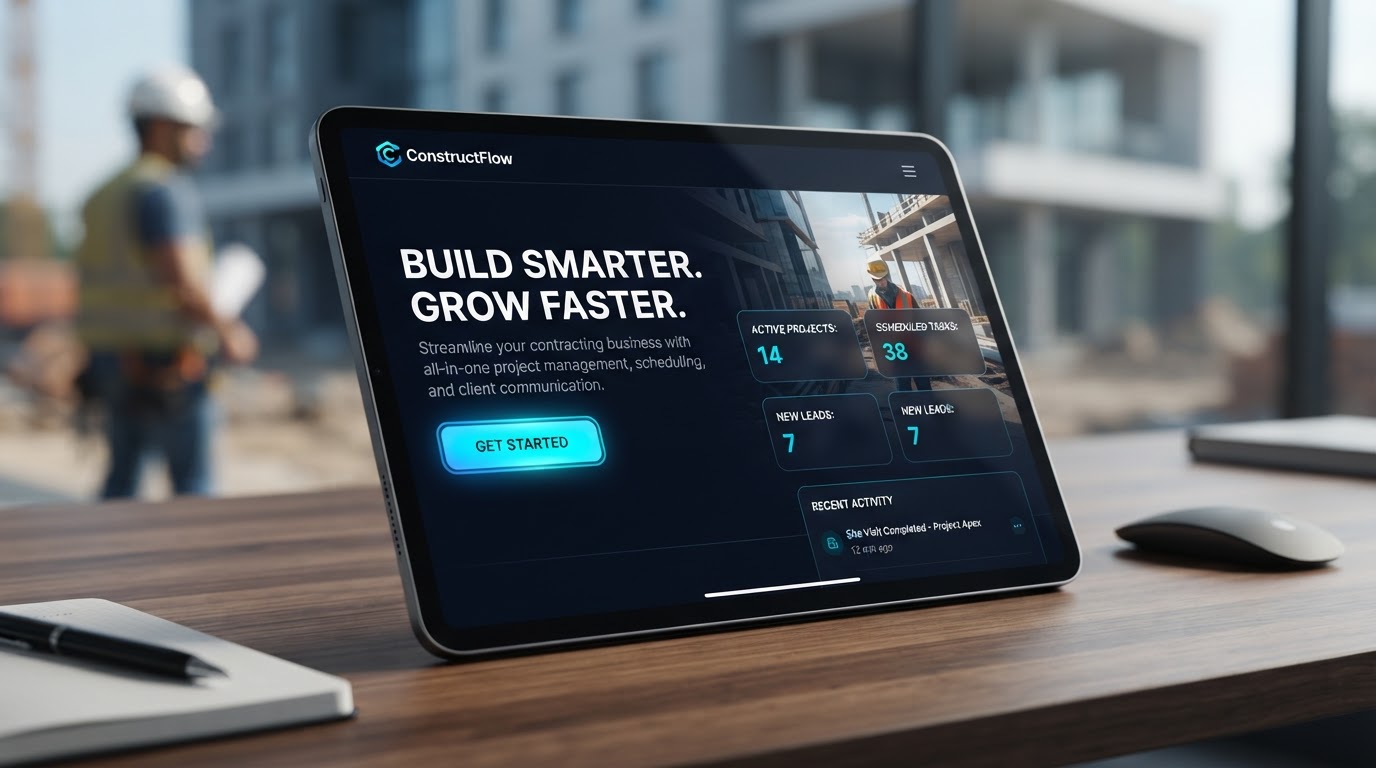
Stop picturing your site as a homepage with a menu. Picture it as a funnel — every page a homeowner lands on has one job, and the job is the same: get them to reach out. Here’s the layout that does it.
Above the fold: your trade, your service area, and a reason to trust you (reviews, years in business, a photo of real work) — with a click-to-call button and a form both visible before the first scroll. If someone has to hunt for how to contact you, you’ve already lost them.
Service pages, not a services menu: a dedicated page for each thing you do, each one optimized for the search someone’s actually running (“tree removal near me,” not “services”). Each one answers the three questions a homeowner has before they’ll call: what does it cost, how fast can you get here, and can I trust you.
Social proof in the path, not a separate tab: reviews and before/after photos woven into the pages where a hesitant buyer is already looking. Not a “Testimonials” page no one clicks — the proof lives right next to the button.
A form that takes ten seconds: name, phone, what do you need. That’s it. Every field you add is a homeowner deciding it’s not worth it and closing the tab.
4. From Visitor to Booked Job — Without Anyone Picking Up the Phone
Here’s where most contractors lose the lead, and it’s not where you think. The homeowner fills out the form. Then… nothing. Nobody’s watching the inbox. The follow-up happens tomorrow, or next week, or never. By the time someone calls back, the homeowner already booked the second contractor on the list.
The sites we build close that gap. A form submission fires an instant text-back — “got it, we’ll reach out in the morning” — so the lead knows they’re not shouting into a void. It drops into the CRM with a task. If it’s after hours, the automation queues the follow-up for first thing in the morning instead of letting it sit until someone remembers. The lead that would’ve gone cold overnight stays warm because the system caught it the second it came in.
That’s the part that turns a “nice website” into a lead generator. Not the design. Not the SEO. The fact that when someone raises their hand, something on the other end actually catches it — every time, without you having to manage it.
If you’re tired of a site that looks fine and produces nothing, that’s the conversation we’d have. Schedule a website development consultation.