Every “we’ll automate that later” quietly compounds into manual hours, broken onboarding, and operational debt. Here’s how to tell when “later” has already cost you too much.
There’s a phrase that quietly costs small businesses more than almost any other, and it almost never gets said out loud in a meeting. It shows up in the hallway, or over a shoulder at the end of a long day: “We’ll automate that later.”
It sounds reasonable in the moment. You’re busy. The thing works if someone babysits it. The real fire is the customer on hold, not the spreadsheet that fires the follow-up. So you patch it with a person and move on. And because the workaround works, the automation never comes—until one day you realize the workaround is now the process, and the process is quietly expensive.
Here’s what “later” is actually costing you while it waits—and a simple gut-check for whether later has already arrived.
1. Manual Hours Compound Quietly, Month Over Month
The thing about a manual task is that it doesn’t cost much on any single day. It’s fifteen minutes here, twenty minutes there, a quick copy-paste between two systems before lunch. Nobody writes a ticket for it. Nobody flags it in a review. It just happens, every day, because someone has to do it.
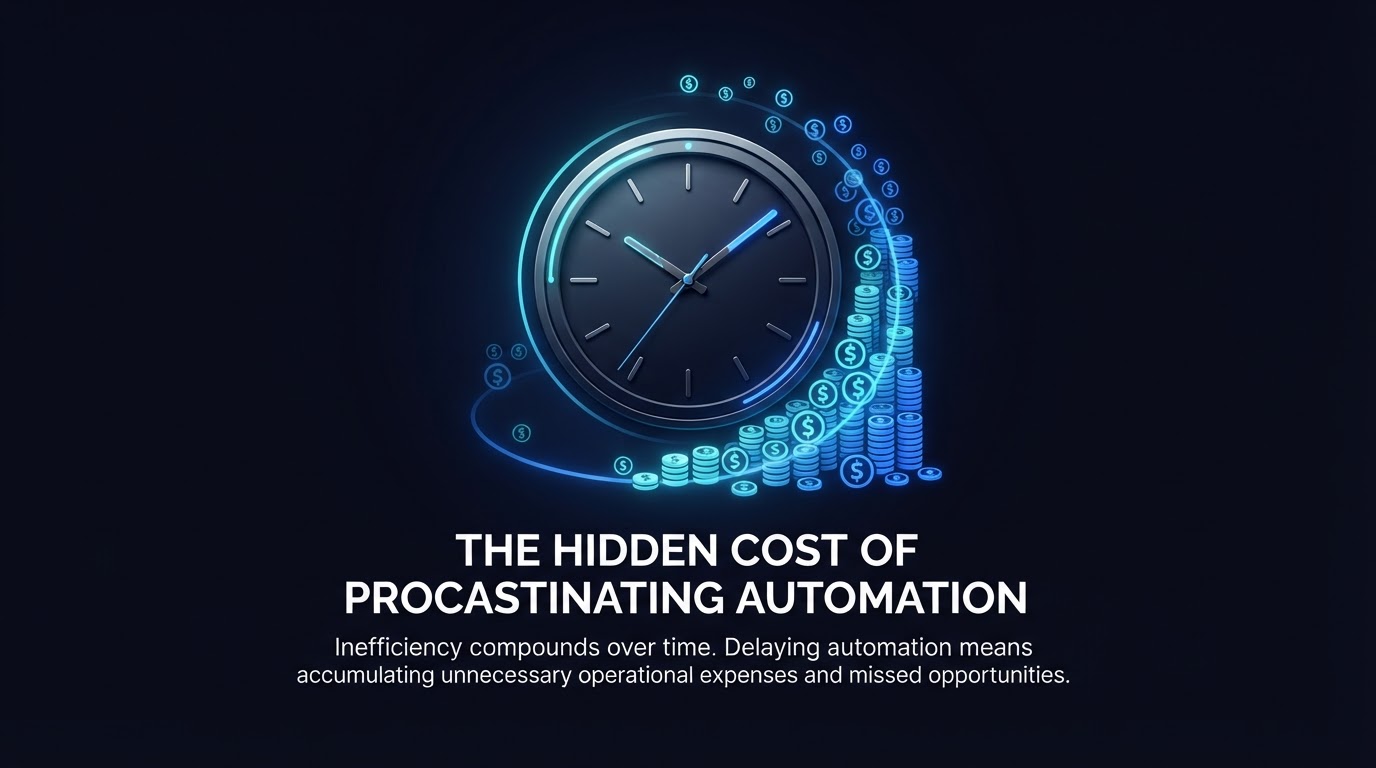
But those minutes don’t stay small. They stack. A task that eats three hours a week is twelve hours a month, a hundred and forty-four hours a year. That’s over three and a half work weeks of a person’s year spent doing something a system could do in seconds. And because nobody tracks it—because it’s just “part of the job”—the cost is invisible until the person doing it leaves and you realize nobody else knows how it works.
The worst part is that the cost compounds, not just in hours but in opportunity. Every hour someone spends on a task a machine should own is an hour they’re not spending on the work you actually hired them to do—the work that grows the business. The busywork doesn’t just cost time. It costs the better use of that time.
2. New Hires Get Trained Into a Broken Process Instead of a Fixed One
Here’s where the cost of “later” gets genuinely expensive—and genuinely hard to unwind. When you bring a new person on, you don’t hand them a clean system. You hand them the process as it currently exists, workarounds and all. And because they don’t know any better, they learn it. They get good at it. Within a month, they’re the new expert on a process that was never supposed to work this way.
Now you’ve got two people invested in the broken version. Three, if you hire again. Every new hire compounds the problem because they’re trained into the debt instead of out of it. The process gets harder to fix, not because the fix is technically harder, but because more people have built their daily routine around it. Fix it now and you disrupt their workflow. Leave it and the debt deepens.
This is how “later” turns into “never.” The window to fix something cheaply is almost always before it becomes someone’s job. Once it’s a job, you’re not just automating a task—you’re asking someone to give up the thing they were hired to do. That’s a harder conversation, and one most owners avoid until the process breaks for good.
3. Technical Debt Shows Up in Operations, Not Just Software
“Technical debt” is a term software people throw around to describe the cost of cutting corners in code—building something fast today that you’ll have to rebuild later. It’s a useful idea, but it’s not just a software problem. Operations have debt too, and it’s usually worse, because nobody calls it that.
Every manual workaround, every spreadsheet that bridges two systems that should talk to each other, every reminder you have to set by hand because the system doesn’t—that’s operational debt. It doesn’t show up on a balance sheet. It shows up as the slow drift in your team’s capacity, the tasks that take longer this quarter than last, the fires that used to be rare and now are weekly. And just like code debt, it accrues interest: the longer it sits, the more it costs to fix, because the workaround has woven itself into more of how the business runs.
The businesses that stay lean aren’t the ones that never accumulate operational debt—everyone does. They’re the ones that pay it down before it compounds into a crisis. They treat a recurring manual task the way a good engineering team treats a messy function: as a sign that something needs to be rebuilt, not babysat—indefinitely.
4. A Simple Gut-Check for Whether “Later” Has Cost Too Much
You don’t need a time-tracking study to know when later has already arrived. Here’s the gut-check we’d give any owner who’s unsure:
Pick the task you keep saying you’ll automate later. Now answer three questions honestly. Could the newest person on your team explain how it works without help? Has it ever caused a customer-facing delay—a late follow-up, a missed reminder, a reply that sat too long? And if that one person who runs it walked out tomorrow, how long before something breaks?
If you flinched on any of those, “later” isn’t a plan—it’s the cost you’re already paying. The honest truth is that the businesses that win at this aren’t the ones with the most automation. They’re the ones that stop treating manual workarounds as temporary when they’ve clearly become permanent. If a “temporary” fix has been running for six months, it isn’t temporary anymore. It’s the system. And the longer you wait to replace it, the more it’s costing you in hours you can’t see and breaks you can’t predict.
You don’t have to rip everything out at once—that’s the other trap. Start with the one task that makes you wince when someone brings it up. That’s the one “later” has already cost you enough on. Find out what “later” is costing you.