Fall Planning: Where AI Ops Fits Into Your Q4 Priorities
Q4 doesn't wait for January. Here's how to automate year-end reporting, plan capacity for the busy season, and prep your budget — before the scramble starts.
There's a specific kind of chaos that hits every service business between mid-October and December. The phone rings more. The calendar fills up. Existing customers want last-minute work squeezed in before the holidays. And somewhere in the middle of all of it, someone realizes the year-end reports are due in three weeks and nobody's started them.
Fall is when the businesses that planned ahead pull ahead of the ones that didn't. And the planning that matters most isn't a strategy deck — it's operational. It's deciding, right now, what you're going to automate before the busy season makes it impossible to think straight. Here's where AI Ops fits into your Q4 priorities, and why the window to set it up is already narrowing.
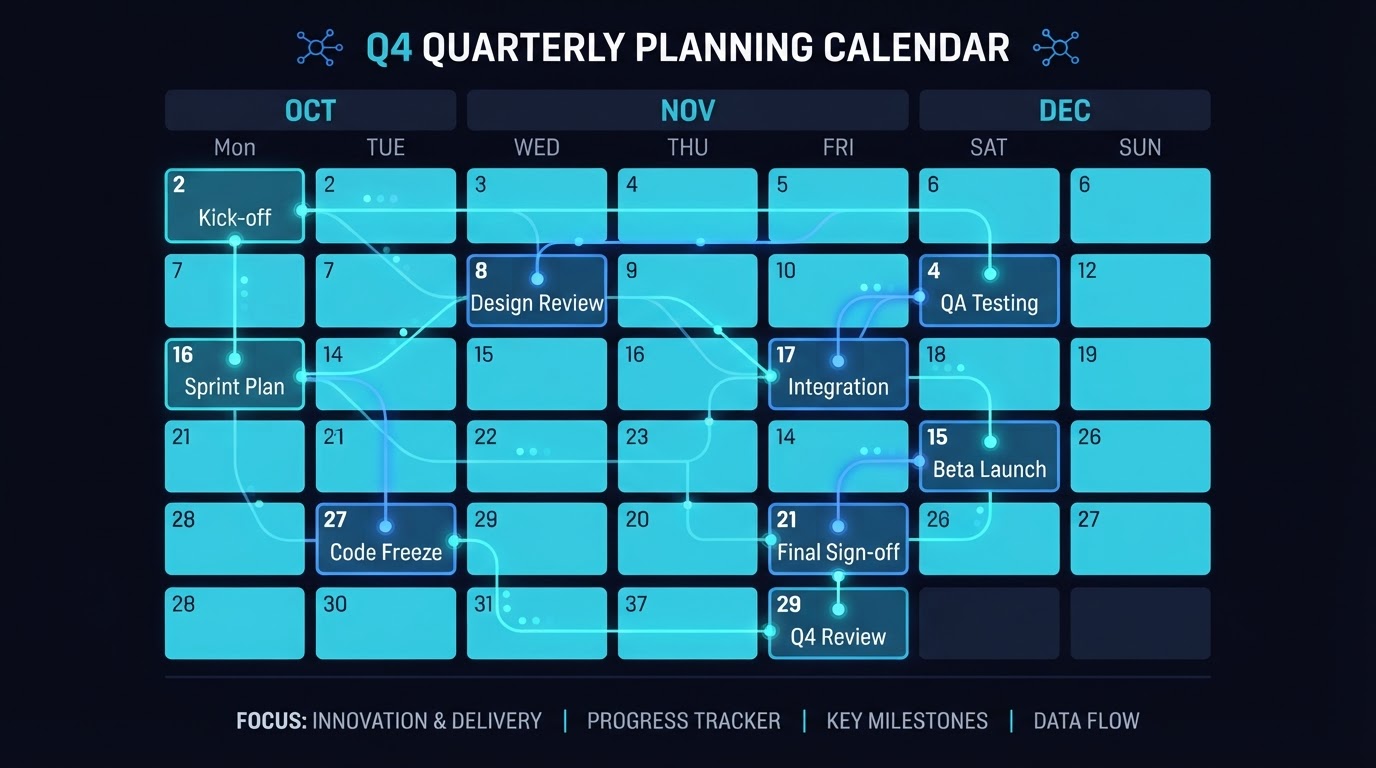
The Q4 AI Ops Timeline
1. Year-End Reporting Automation Before It Becomes a Scramble
Every December, the same scene plays out. Someone — usually an office manager or an owner who'd rather be anywhere else — spends three or four days pulling numbers from the CRM, the accounting system, the scheduling tool, and a couple of spreadsheets that live on someone's desktop. They paste it all into a document, format it, and call it the year-end report. By the time it's done, the information is already stale and nobody has the energy to act on it.
This is the single easiest thing to automate in Q4, and it's the one that pays back the fastest. An AI Ops system can pull from every connected source — revenue, job volume, lead source, close rate, response time — and assemble a clean report on a schedule you set. Weekly, monthly, end of quarter. No human touches it unless they want to add commentary.
The reason to set this up in the fall is simple: by the time December arrives, nobody has four days to spare. Build the automated report now, let it run for a few weeks to make sure the numbers are right, and your year-end version is already done before anyone asks for it.
2. Capacity Planning Heading Into a Busier Season
If your business has a seasonal peak — and most home service businesses do — Q4 is when you start feeling the pressure of more demand hitting the same number of people. The question isn't whether you'll be busy. It's whether your current operation can absorb the volume without breaking the customer experience.
Capacity planning used to mean guessing. You'd look at last year's numbers, add a fudge factor, and hope you hired or scheduled correctly. AI Ops changes that. With the right system in place, you can see, in real time, where the bottlenecks are forming — which intake forms are stacking up, which follow-ups are lagging, which appointment slots are going unfilled because nobody's confirming them.
More importantly, the system can absorb some of that capacity itself. Automated intake routing, self-scheduling, and follow-up sequences handle the repetitive volume that would otherwise land on a human's desk. You're not replacing your team — you're giving them the bandwidth to handle the work that actually requires a person.
3. Budget Season Prep — Knowing What's Worth Funding Next Year
Fall is also when next year's budget gets built. And most small businesses build that budget the wrong way: by looking at what they spent last year and adding or subtracting a percentage. That tells you what you spent. It doesn't tell you what actually produced a return.
If you've automated even one workflow this year, you have something most businesses don't: a measurable before-and-after. You know how many hours that task used to take, and you know how many it takes now. That's the data that makes budget conversations easy. Instead of arguing about whether a tool is "worth it," you're pointing at a number that says, "this saved us X hours and recovered Y leads."
That's the case for starting now, even on a small scale. Every workflow you automate before budget season becomes a data point that justifies the next investment. The businesses that scale their AI Ops in the new year are the ones that proved it out in the fall.
4. A Realistic Timeline for Rolling Something Out Before Year-End
Here's the part that trips people up. They read about automation in October, get excited, and assume they can have a full system live by November. That's not realistic — and trying to rush it is how implementations fail.
A realistic Q4 rollout looks like this: two weeks to scope and measure one workflow. Two weeks to build and test it with real data. Two weeks to run it live alongside the manual process so the team builds trust and the edge cases get caught. By Thanksgiving, you have one automated workflow running cleanly — and the foundation to add the next one in the new year.
That's not slow. That's responsible. The businesses that try to automate five things by December usually end up with five half-built workflows and zero of them actually running. One thing, done well, live before the chaos — that's the win.
If you're looking at your Q4 calendar and realizing the window is already tight, that's exactly the conversation we should be having. We'll help you find the one workflow that matters most, scope it honestly, and get it live before December makes everything harder. Plan your Q4 AI Ops rollout with us.