The Difference Between a Chatbot and a Real AI Operations System
A chatbot answers questions. An AI operations system takes action. Here's how to tell them apart — and what to ask a vendor before you buy either one.
Every vendor in 2026 has an "AI assistant." Open any software dashboard and there's a little chat window in the corner, ready to answer questions. It's become a checkbox feature — something companies bolt on so their product page can say "AI-powered" without changing anything about how the product actually works.
But there's a real difference between a chatbot that recites pre-written answers and an AI operations system that actually does things. If you're a small business owner trying to figure out which one you're buying, that difference matters. One saves you a few support emails. The other runs part of your operation.
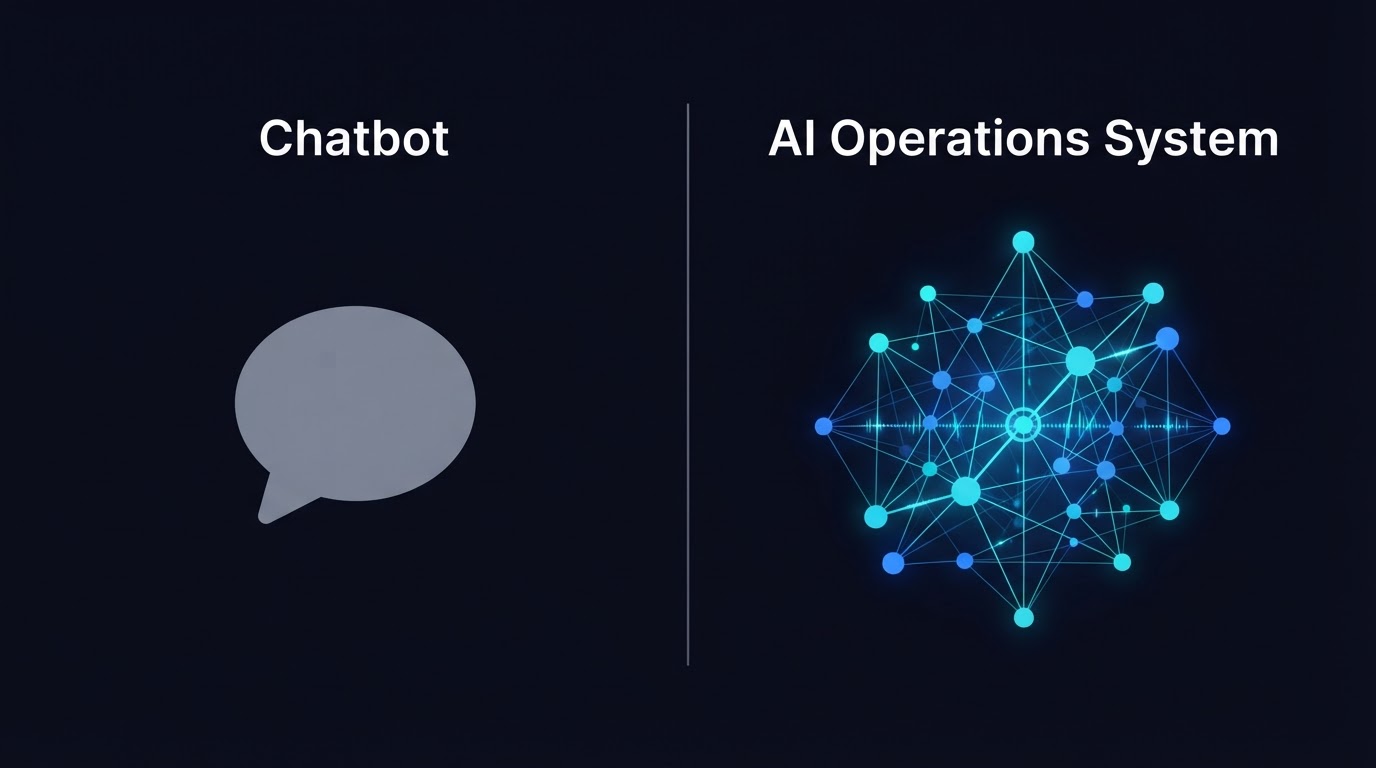
Chatbot vs. AI Operations System
- • Scripted responses to common questions
- • Lives in one window, answers only there
- • Can't take action outside the chat
- • Breaks on anything outside its script
- • Reasons through novel situations
- • Connects to your CRM, calendar, and tools
- • Takes action — books, updates, follows up
- • Handles edge cases and escalates when needed
1. Scripted Responses vs. Actual Reasoning and Follow-Through
A chatbot is, at its core, a decision tree. Someone writes out the ten questions customers ask most often, writes an answer for each one, and the bot matches keywords to surface the right reply. Ask it something off-script — "Can I reschedule to next Thursday and add a gutter cleaning to the same visit?" — and it either freezes, loops back to a generic menu, or hands you off to a human who could have answered in the first place.
A real AI operations system doesn't rely on a fixed script. It reasons through the request: it understands you want to reschedule, checks the calendar for Thursday availability, confirms the original appointment, sees that gutter cleaning is a service you offer, adds it to the work order, updates the CRM, and sends you a confirmation — all in one pass. It follows through on the entire chain of actions, not just the first sentence of your question.
That follow-through is the whole point. A chatbot tells you what the answer is. An operations system does something about it. For a busy contractor, that's the difference between a tool that saves a phone call and a tool that replaces one.
2. Integration Depth — Does It Just Answer, or Does It Take Action?
Here's the quickest way to tell the two apart: ask what happens after the conversation ends. A chatbot's job is done when it prints a response. The information lives in the chat window, and if nobody copies it somewhere else, it vanishes. The lead who asked about pricing? Still not in your CRM. The appointment someone tried to book? Still not on your calendar.
An AI operations system is built around integrations. It's connected to your CRM, your calendar, your payment processor, your phone system, and your email — so when a conversation happens, the actions happen with it. A lead gets created. An appointment gets booked. A follow-up task gets assigned. A confirmation text goes out. The system doesn't just talk to your customer; it talks to your business, and it updates the records that matter without a human touching them.
This is why integration depth is the single biggest dividing line. A chatbot is a layer on top of your tools. An operations system is wired into them. One observes your business; the other operates it.
3. Reliability Under Real Business Conditions, Not a Demo
Demos are easy. A vendor walks you through three perfectly scripted scenarios, the bot nails all three, and everyone nods. Then you go live, and a customer sends a message at 11 p.m. that's half question, half complaint, with a photo attached and a request to change their appointment. That's real business conditions — messy, unpredictable, and nothing like the demo.
A chatbot falls apart here. It wasn't built for ambiguity. It either ignores the photo, misreads the request, or fires off a canned response that makes the customer feel unheard. The result is a worse experience than if no bot existed at all — because at least silence doesn't actively frustrate people.
A real AI operations system is designed for exactly this. It handles the messy input, extracts the actual intent (reschedule + complaint about a previous visit), takes the right action (moves the appointment, flags the complaint for follow-up, sends an acknowledgment), and knows when to escalate to a human instead of guessing. Reliability isn't about getting the easy cases right. It's about handling the hard ones without making things worse.
4. What to Actually Ask a Vendor Before Buying Either One
If you're evaluating an "AI assistant" for your business, stop listening to the marketing and start asking specific questions. The answers will tell you immediately whether you're looking at a chatbot or an operations system.
- "Can it take action, or only answer questions?" If it can't book an appointment, update a record, or trigger a workflow on its own, it's a chatbot.
- "What systems is it actually connected to?" A list of real integrations — CRM, calendar, phone, email — means it operates your business. A standalone widget means it doesn't.
- "What happens when it doesn't know the answer?" A good system escalates to a human cleanly, with context attached. A chatbot loops, apologizes, or goes silent.
- "Show me a real customer conversation, not a demo." If they can't, or if every example is a simple FAQ, you're looking at a script — not a system.
- "Does it get better over time, or is it frozen?" An operations system learns from real interactions and improves. A chatbot is only as good as the last time someone manually updated its scripts.
The vendors who've built real systems will answer these questions easily and specifically. The ones selling a chatbot will get vague fast. That vagueness is the tell.
If you're tired of "AI" that's really just a glorified FAQ widget, that's exactly the gap we built Jethro to fill. It doesn't just answer — it acts, integrates, and follows through. Ask us what makes Jethro different.