Your ops team is drowning in repetitive tasks that an AI agent could handle in seconds. Here's where to start cutting the noise — and why small teams feel it fastest.
If you run a small operations team, you already know the feeling. It's 4:30 on a Friday and half the week's actual work — the strategic stuff, the customer-facing stuff, the things that move the business forward — still isn't done. Not because your team isn't capable. Because they spent Monday through Thursday buried in busywork that nobody hired them to do.
Copying data between systems. Chasing down status updates. Manually routing emails. Building the same report from scratch every week. Answering the same five questions from the same three customers. None of it requires a senior decision-maker. All of it ends up on a senior decision-maker's desk anyway.
That's the gap AI agents are built to close — and small ops teams are where the impact shows up fastest.
1. Small Teams Feel the Relief First
There's a reason enterprise companies talk about AI in terms of "efficiency at scale" and small businesses talk about it in terms of "getting our Fridays back." When you have a 40-person operations department, automating a task saves a few minutes per person. When you have a four-person ops team — or you are the ops team — automating a task can give someone their entire afternoon back.
Small teams don't have slack. Every hour spent on busywork is an hour not spent on the work that actually matters: closing deals, fixing processes, talking to customers, planning the next quarter. When an AI agent takes over a repetitive task, the relief is immediate and personal. You don't need a dashboard to see the ROI. You can feel it by 5 p.m. on a Wednesday.
That's why small ops teams are often the first to adopt AI agents successfully. The payoff isn't theoretical. It shows up in the same week you implement it.
2. The Busywork AI Agents Handle Best
Not every task is a good fit for an AI agent. The ones that work best share three traits: they're repetitive, they follow a predictable pattern, and they don't require creative judgment. Here's what that looks like in a real small ops team.
Data entry and record updates. Every time a lead comes in, a form gets submitted, or a customer calls, someone manually logs it. An AI agent captures that information the moment it arrives and writes it straight into your CRM — no double entry, no typos, no leads sitting in an inbox for three days.
Scheduling and calendar coordination. The back-and-forth texts to book a job, the reminders to cut no-shows, the rescheduling when something changes — an AI agent reads your calendar in real time, offers available slots, books the appointment, and sends the confirmation. Your team stops playing phone tag.
Status reports. Somewhere in your operation, someone is pulling numbers from three systems every Friday and pasting them into a document. An AI agent assembles that report automatically and delivers it on schedule — consistently, even when the week was chaotic.
Email triage. A shared inbox is where efficiency goes to die. An AI agent reads incoming emails, categorizes them by intent, and routes each one to the right person instantly. Nothing sits waiting for someone to notice it.
None of these tasks are glamorous. That's the point. They're the invisible tax on your team's time, and they're the first things an AI agent should take off your plate.
3. Start With One Task, Not a Platform
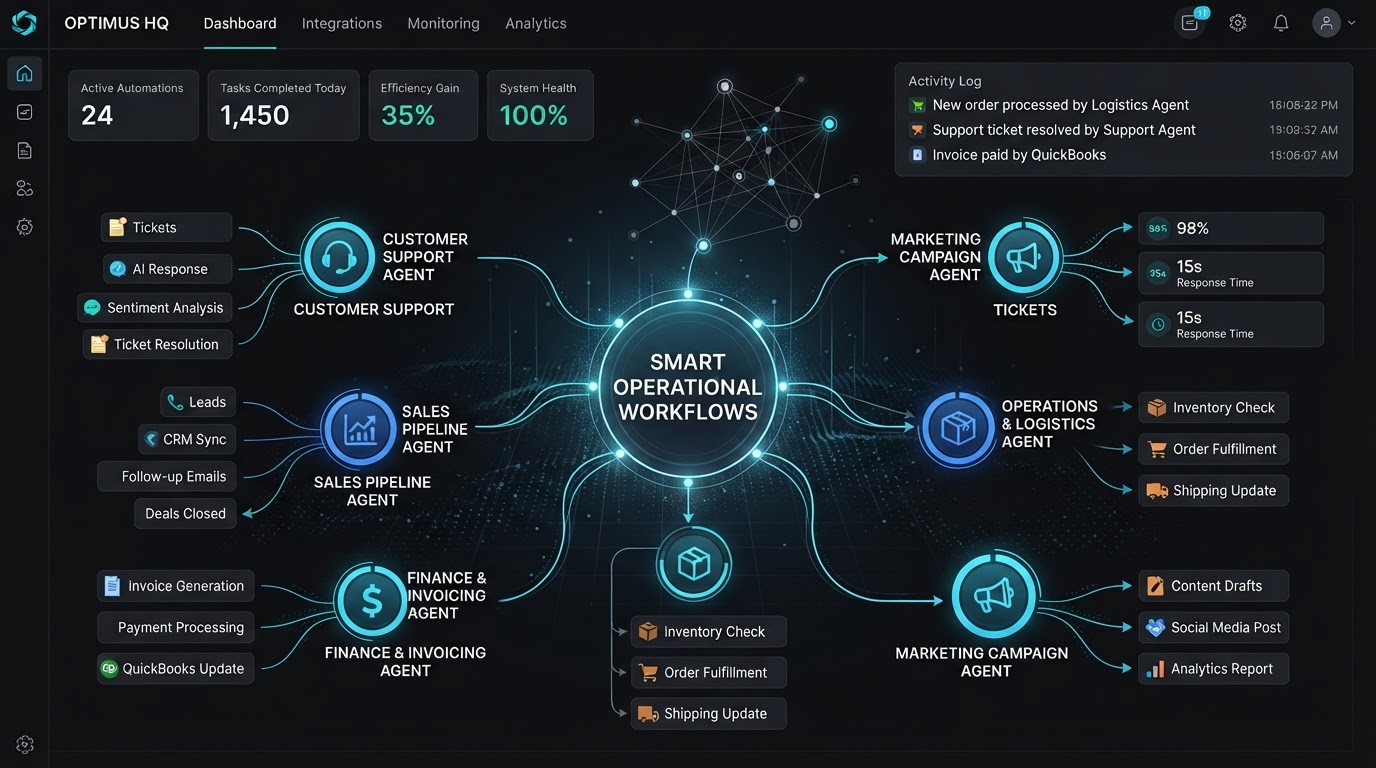
The most common mistake small teams make with AI is trying to automate everything at once. They map out a dozen workflows, buy three tools, and attempt a full operational overhaul in a weekend. Something breaks, the team loses confidence, and the whole initiative gets shelved as "too complicated."
The teams that actually succeed pick one task — usually data entry or scheduling, since they're the most predictable — and automate just that. They watch it run for two weeks. They let the team get comfortable. They fix the edge cases. Then they add the next one.
Each automated task frees up time that makes the next automation easier to implement and test. By the end of a quarter, you've quietly replaced dozens of manual hours with a system that runs itself — and your team is spending their time on work that actually requires a human.
4. The Compounding Effect Nobody Talks About
Here's what most people miss about cutting busywork: the benefit isn't just the hours saved. It's what your team does with those hours.
When someone stops spending six hours a week on data entry, they don't just get six hours back. They get six hours of attention back — the mental bandwidth to think about the customer who's been waiting, the process that's been broken for months, the opportunity you keep saying you'll chase next quarter. Busywork doesn't just eat time. It eats focus. And focus is what small ops teams need most.
That's the real case for AI agents in a small operation. It's not about doing more with fewer people. It's about giving the people you have the space to do the work they were actually hired to do.
If you're ready to find that first task and cut it loose, that's exactly the conversation we'd have. See how Jethro fits into your operations.